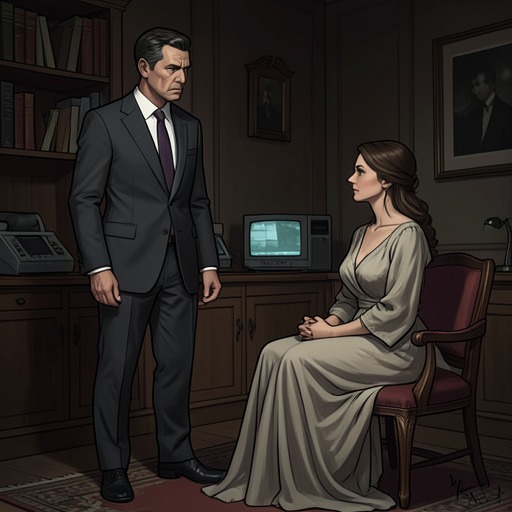
Kouichi investigated the former residence of Daisuke in Osaka
A ManKyoichi Taniguchi’s visit to the management office of his missing brother Daisuké’s former Osaka apartment turns a small piece of routine detective work into evidence of when Daisuké lost his identity. The inquiry establishes that Daisuké was still himself before his encounter with X, while the office’s guarded response leaves the search with a new lead but no immediate address.
Background and Purpose
Kido had traced the address recorded for Daisuké before he moved to Town S: a very cheap, dilapidated apartment beside the Yodo River in Osaka City’s Kita district. He proposed that he, Rié, and Kyoichi visit together. Before Rié could answer, however, Kyoichi said he had business in Osaka and went to the nearby management office on his own, meeting the company president.
The search carried added urgency because the family had heard nothing from Daisuké since the earthquake. Kyoichi had initially shown little initiative, wary of stumbling into trouble, but their mother had tearfully scolded him and urged him to look harder; she desperately wanted to see her younger son again before she died. The Osaka inquiry thus began against a background of both unresolved suspicion and a family’s fear that time was running out.
The Inquiry at the Management Office
Kyoichi told the president that his brother was missing. After studying a photograph of Daisuké, the president said he felt fairly certain Daisuké had lived in the apartment. Kyoichi then showed him a photograph of X; the president shook his head, saying the face did not ring a bell. The comparison made the result more specific than a simple confirmation of residence: the man remembered at the apartment looked like Daisuké, not X.
From that distinction, Kyoichi concluded that Daisuké had continued to live as Daisuké until his time in Osaka. He must have encountered X later, after which his name and family register were taken from him. Kyoichi had arrived at this reconstruction through what he regarded as the simplest detective work in the world. Its plainness intensified his anger at the police for not having bothered to make the same inquiry.
A Lead Left Unresolved
Near the end of the meeting, Kyoichi asked for Daisuké’s telephone number and forwarding address, assuming they might have been recorded when he left the apartment. The president, who had been cooperative up to that point, suddenly became wary, as though he had recognized the possibility of getting drawn into trouble. He ended the conversation evasively, saying he did not know whether the files still existed but would check.
Kyoichi understood the president’s caution as fear of becoming entangled in the case and considered it understandable under the circumstances. The president did not contact him afterward. The visit therefore supplied a crucial boundary in the timeline of Daisuké’s identity theft, but stopped short of revealing where Daisuké had gone next.
Significance in the Search
The episode contrasts the modest reach of an ordinary inquiry with the consequences of institutional inaction. A photograph, an old address, and a conversation with a company president were enough for Kyoichi to establish that Daisuké had not always been living as X. That finding redirected the question from whether the missing man had simply disappeared to how and when his name and legal identity had been taken.
Kido later considered why Kyoichi had gone to Osaka without the others and why he had asked Misuzu to create a Facebook account for his brother. Watching the exchanges among Kyoichi, Misuzu, and Misuzu posting as Daisuké, Kido gradually worked out what Kyoichi was pursuing. The Osaka visit thus belongs to a broader, deliberately indirect search: Kyoichi’s method may have yielded an important clue, but Kido’s understanding of the plan did not make him willing to support it.